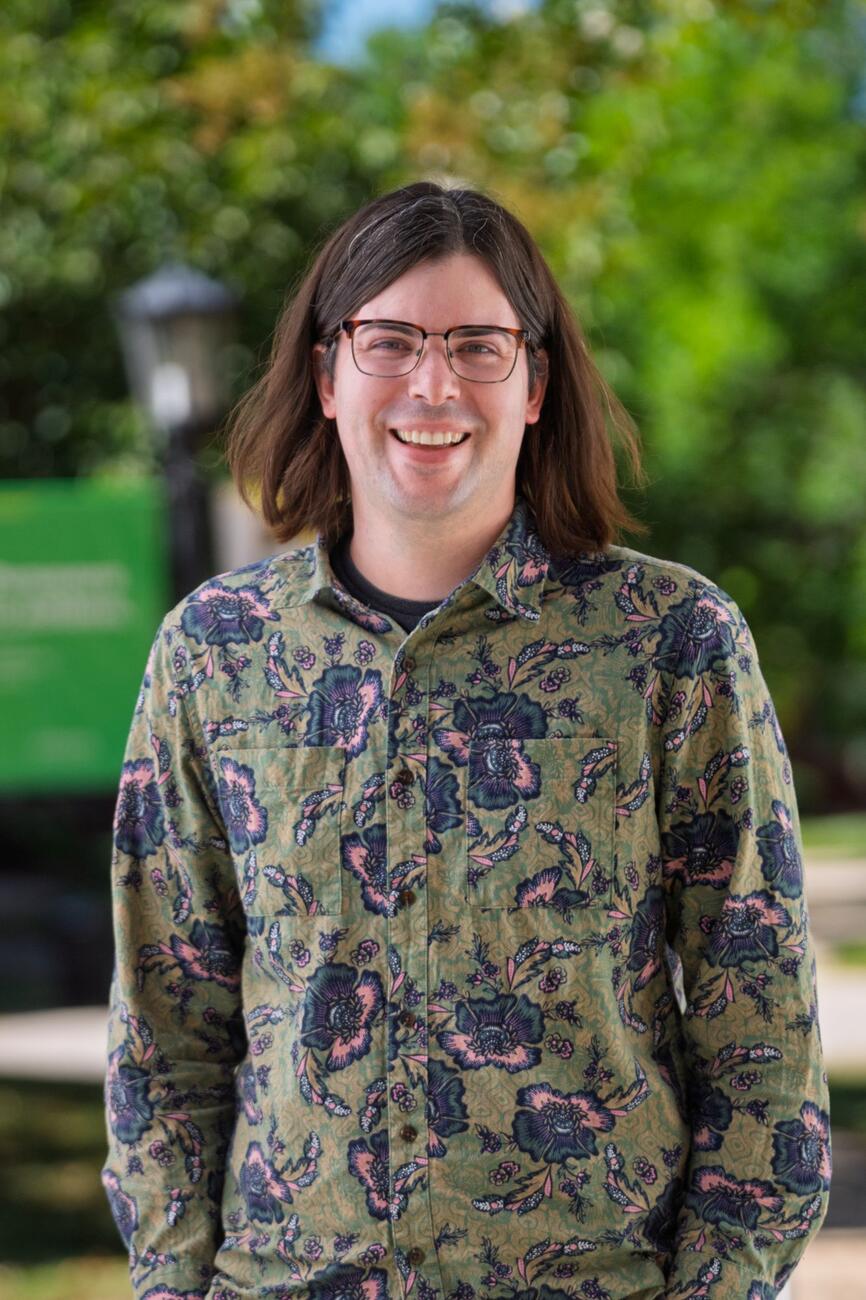
Timothy Swartz, Ph.D.
An applied ecologist investigating biodiversity in urban and agricultural landscapes.
Timothy Swartz grew up playing in the creek and woods, collecting critters, rocks, and leaves from nature. A college Tropical Biology course in Costa Rica clinched it: Timothy was destined to be a biologist. “I love teaching liberal arts students in science classes because they are so excited to cross disciplinary boundaries and draw on their broad academic experiences to find ways to solve ecological problems,” Timothy says. With a B.S. in Biology from Messiah University, an M.S. in Natural Resources and Environmental Sciences from University of Illinois at Urbana-Champaign, and a Ph.D. in Biology from Temple University, Timothy is excited to teach the next generation at McDaniel.
What’s your specialization within Environmental Studies?
I am an applied ecologist with an interest in conserving biodiversity in urban and agricultural landscapes. In practice, I take an ecological theory and apply that to a problem people are trying to solve, like how we can improve the biodiversity of our farms and cities. This has the potential to help reverse the growing global disconnect between people and nature. And people don’t work to protect things they don’t have a personal connection to. So, my goal is to try to find ways to boost the biological diversity of where we live and work and help (re)forge connections between us and the rest of the living world.
What classes are you teaching this fall?
Urban Ecology and Restoration Ecology. Both get students into the environment to learn how people impact nature and vice versa. For Restoration Ecology, I’ve coordinated field trips with local environmental organizations and put together a cool list! Highlights are a floating urban wetland in the Baltimore Inner Harbor, a stream restoration site here in Carroll County, and a native plant landscaping company in Ellicott City. These will introduce students to the amazing things that folks are doing to restore biodiversity in our region and may spark career interests.
How will your research experience influence your teaching in the classroom?
In my teaching, I like to find ways to make students my partners in exploring novel ideas or techniques I might use in my research. Students enjoy working together to design an experiment where even I don’t know the outcome. In Urban Ecology, my students and I will use trail cameras to collect photos of wildlife in and around Westminster. Together, we’ll select sites, develop a protocol for managing the images, and explore ways of analyzing the data for their final projects. After we’ve worked out some of the bugs, I plan to expand the camera network throughout Carroll County. Ultimately, I plan to contribute the data to a national camera trapping dataset used by researchers across the country. I’ve implemented this hands-on, student-led approach in prior courses I’ve taught, and I’m excited to put it into practice here at McDaniel!
About Prof. Swartz
Assistant Professor of Environmental Studies
Subject: Environmental Studies
Department: Environmental Studies
Birdwatching, especially during seasonal migrations.
They recently visited the Caribbean coast of Colombia and plan to go to the Andes in Ecuador.
The best book they read recently was “Pests: How Humans Create Animal Villains” by Bethany Brookshire.