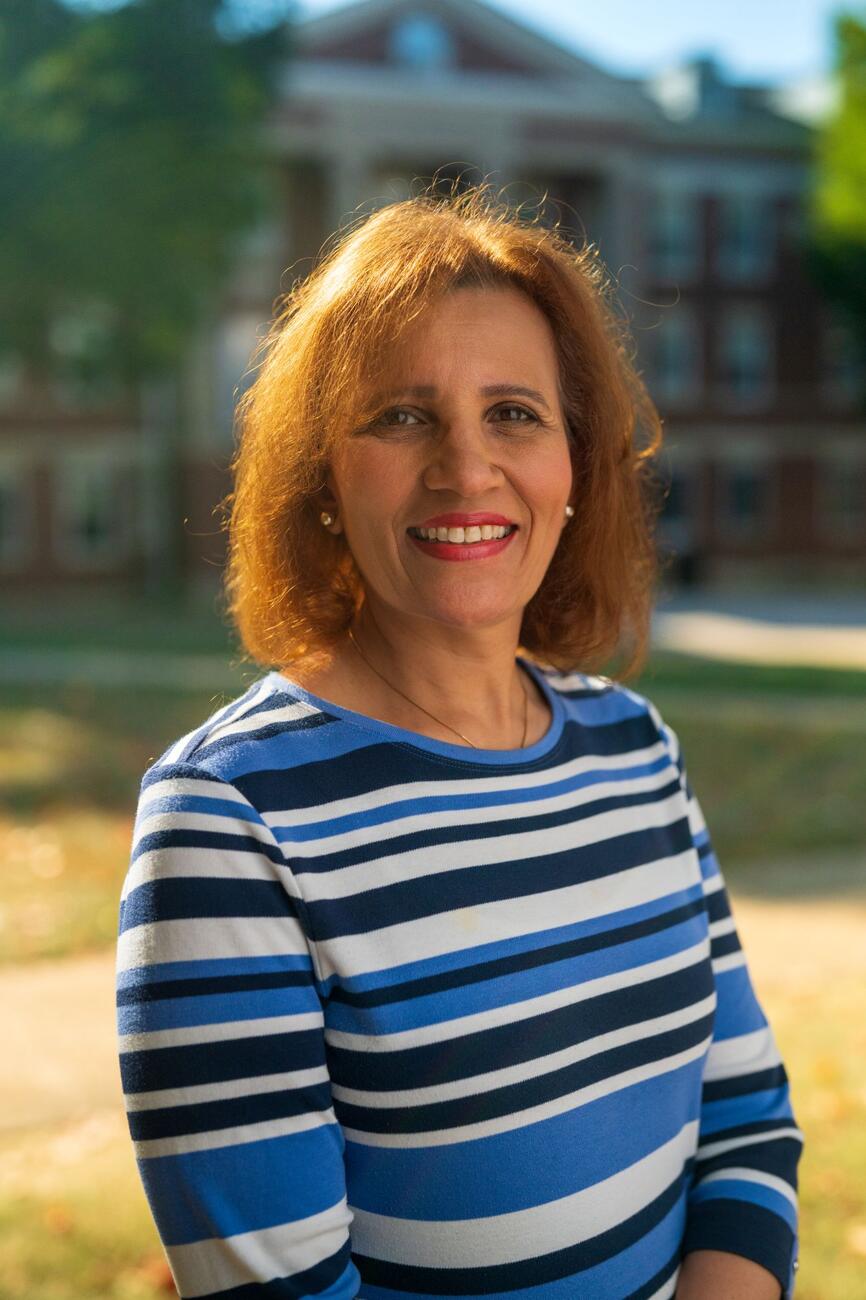
A global economist interested in how the big picture affects families and communities.
Dina Rady is fascinated by economic development, how countries grow, reduce poverty, and create better lives for their people. It’s “a mix of puzzle-solving and humanity,” she says. She encourages students in her classes — Economic Development, Public Economics, and Statistics — to make connections between their lessons and their real lives. She holds a B.A. in Business Administration from Ain Shams University in Cairo, an M.A. in Economic Development from American University, and an M.A. and Ph.D. in Economics from Ain Shams University.
What first led you to study Economics?
I was always fascinated by the big question of why some countries prosper while others struggle, and I wanted to understand the forces shaping people’s everyday lives. My curiosity grew into a passion (inspired by my father — also a professor of Economics), when I realized economics isn’t just theory, it’s about real choices, opportunities, and challenges that affect families and communities. Plus, I’ve always loved graphs and charts!
How do your previous research and experiences influence your teaching?
My favorite research I’ve done was on “Egypt’s Economic Transition: A New Beginning” — it’s special because it bridges my professional expertise with a personal connection to my home country. My teaching is shaped by a blend of academic research and international experiences. I bring theory to life by connecting abstract concepts to real-world case studies. Students don’t just learn economics in my classroom, they get to see how it plays out in policy debates, business decisions, and everyday life decisions. Together, we explore how policies, infrastructure, and institutions actually change lives. It’s like being both a detective (searching for patterns and solutions) and a problem-solver (designing ways forward).
What do you hope students take away from your Economics classes?
My biggest hope is that students walk away realizing Economics is so much more than numbers and equations. It’s about people, how choices are made, how resources are shared, and how societies can build better futures. If students leave my class thinking differently about the world around them and feeling empowered to contribute to positive change, then I’ve done my job.