Skip to main
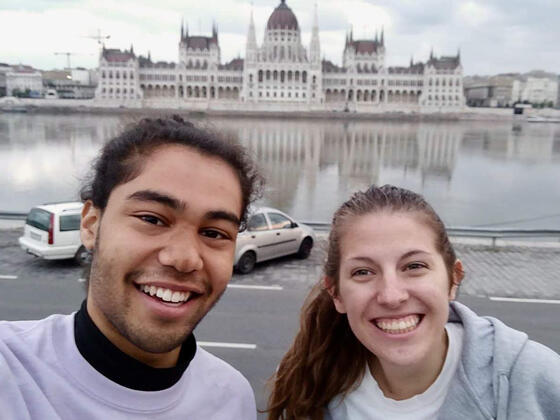
Students sitting outside of Budapest campus.

Political Science - International Studies

Trade policy. Economic stability. War. Peace. There’s a lot at stake when the nations of the world interact with each other. But what laws and structures are in place to help guide this process? How do we attempt to resolve conflicts? And who gets to have a say?

Mortarboard
Degree Types
Major, Specialization
Institution
Complementary Programs
Heart
Distinctive Requirements
Internship
Document
Professional Preparation
Pre-Law, Internships in Washington D.C.

International Studies, one of two specializations in the Political Science major, is the exploration of these complex questions.

The study of politics as both an art and a science involves understanding how ancient, modern and post-modern thinkers have come to understand the political world both philosophically and empirically on national, local, and international levels. In McDaniel’s Political Science program, you’ll learn about the processes of government, the avenues for participation in the political system and in government, as well as the actors involved and the means by which they exercise power, influence, and authority. 

Future Career Paths

Political Science graduates have gone on to great success in a variety of career fields. For example, one graduate is serving in a high-level capacity at the Department of Homeland Security working on counter-terrorism. Many work for the National Security Agency (having been recipients of the NSA Scholarship while at McDaniel).  Several have gone abroad for graduate studies at The University of London’s School of African and Oriental Studies, the London School of Economics, and the Sorbonne in France.

It’s very common for students to finish McDaniel and then go on to:

  • Graduate schools
  • Law schools
  • Careers in government (at the local, state, or national levels)
  • Development work with non-governmental organizations
  • Advocacy groups
  • Journalism
  • Lobbying

Distinctive Courses

PSI 2203- International Law and Organization

An introduction to the history, purpose, environmental policy and scope of international law and organizations. Questions this course attempts to answer include: How does international law affect states, international organizations, non-state actors, and individuals? Who creates international law, and who is governed by it? What is the relation between international and domestic law? What role do international organizations play in the international system? How does membership in international organizations influence states' abilities to achieve their goals?


PSI 2212 - Terrorism and Counterterrorism

This course provides us with the opportunity to examine the phenomenon of terrorism: what is it, what is the logic behind it, and what factors could motivate groups and individuals that engage in it? What are the conditions that make some individuals more susceptible to radicalization and recruitment by terrorist groups? Why do individuals with similar experiences, levels of distress, and grievances opt not to join such movements? We will start with examining the main themes and debates in the academic literature on terrorism; then we will compare different theories and approaches that look into the behavior and motivation of terrorist groups and individuals. The goal is to familiarize students with different perspectives and tools to better understand the alternative narratives about terrorism, and the possible motives and behavior of terrorist groups.

PSI 2300 - Model United Nations

This is a course for students who have been selected for the Model United Nations Team. In this course, students will learn about the fundamentals of the United Nations and Model United Nations, conduct research into an assigned state, and undertake skills training relating to negotiation, committee networking, and resolution writing in a diplomatic setting. 

PSI 3333 - Conflict Resolution, Peacemaking, and Peacekeeping in a Post-Cold War World

This course is designed to expose students to the multifaceted nature of conflict on the inter and intra state levels, historically, and in the current post Cold War period. This objective will be achieved by exploring the sources, causes, environmental impact, and determinants of conflict, presenting the various perspectives on the genesis and the amelioration of conflict, and utilizing some case method analysis to demonstrate the life cycles of some specific conflicts and the management or resolution thereof. The cases vary each semester but have included the following: The Middle East Conflict, the Anglo-Irish Conflict, the Gulf War (and now the second war against Iraq), the war on terrorism, and the conflict in former Yugoslavia and Rwanda. The course also covers the spread of radical fundamentalist Islam as a source of conflict in the Post Cold War World and specifically with regard to the “War on Terror.”

Special Opportunities

Learning by doing is one of the hallmarks of McDaniel’s Political Science program. And because of our location near the nation’s capital, you’ll have a number of opportunities to see politics in action.

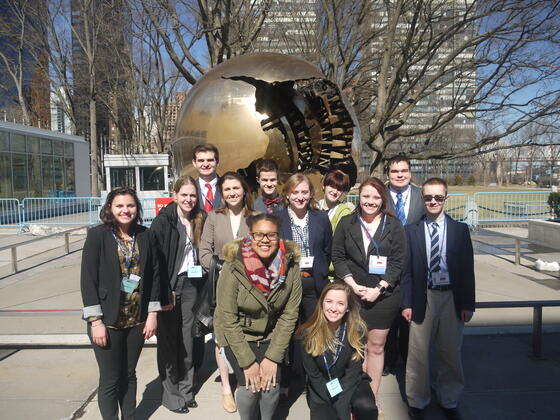
Model UN group in Washington, DC.

Washington Semester Programs of The American University

Students attend a full semester in one of American Universities Washington Semester Programs, and have an internship in any one of the many organizations of government & non-government establishments in D.C. Programs also have travel components to Europe, Africa, and the Middle East.

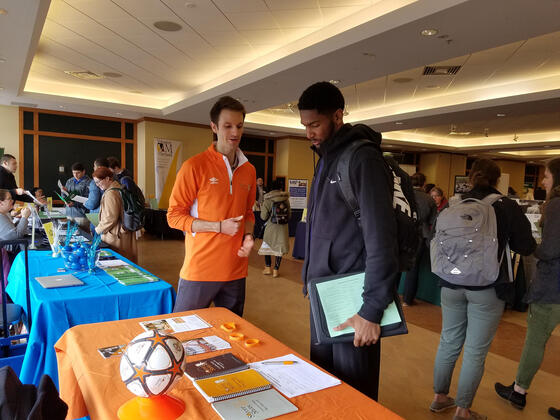
Student sitting behind desk.

Washington Center Internship Program

The Washington Center sponsors yearly programs on such subjects as the presidency, Congress, executive leadership, political campaigns, the legal system, and more. These usually last two to three weeks and are held in Washington, D.C.

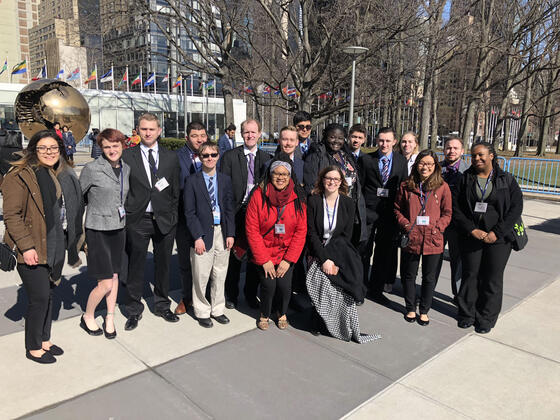
students pose in front of statue

Model U.N., European Union, and Arab League

McDaniel's student delegations for National Model U.N. and the National Model European Union frequently earn recognition for their skillful diplomacy and negotiations at annual conferences. Students have traveled to New York City, Washington, D.C., and even China to showcase their skills in international relations.

The McDaniel Commitment in Action
The McDaniel Commitment—a series of opportunities guaranteed to all students—provides enhanced mentoring and coaching, and ensures every undergraduate student completes at least two meaningful experiential learning opportunities.

Olivia "Kaami" Effa stands outside of the student center wearing a black and white patterned cardigan and tan slacks.

Student Spotlight Olivia “Kaami” Effa '25 Political Science - International Studies | Philosophy double major

International student Olivia "Kaami" Effa developed her skills in intercultural communication during her time at McDaniel. A Global Fellow, she founded an International Perspectives club, studied abroad in South Korea, and participated in Model U.N. With internship experience at The Fund for American Studies, she’s prepared to head into a future working in research, nonprofits, and pursuing law school.

Sana Askari Summer 2023 Internship

Passionate about nonprofits, Political Science major interns with The Fund for American Studies

Sophomore Sana Askari earned the outstanding student award from The Fund for American Studies as part of its Academic Internship Program, which involved enrollment in a college course at George Mason University and an internship with the nonprofit International Child Art Foundation’s Global Arts Olympiad project.

Christianna Nichols Leahy

Faculty Spotlight Christianna Nichols Leahy Professor of Political Science

Professor Leahy teaches such wide-ranging topics as Comparative Politics of Europe, Peacemaking and Peacekeeping in the Post 9/11 World, and Revolutions from 1789 to Occupy Wall Street. She is a human rights activist who has served on the boards of several prominent international organizations, and has expertise in International Humanitarian Law. Every year she takes students to a Model European Union.