Skip to main
Grad student in Hoover Library.

History

It’s a paradox: as a history major at McDaniel, you’ll spend countless hours exploring and investigating things that happened long ago, but you’ll also be developing a skillset—an instinct for research and critical reading, a knack for writing precisely and persuasively, the good judgment required to summarize large volumes of information—that’s more coveted in today’s workplace than ever before.
Mortarboard
Degree Types
Major, Minor
Institution
Heart
Distinctive Requirements
Capstone
Document
Research Opportunities
Carroll County, Washington, D.C., Baltimore

So whether you want to become a professional historian, an archivist, a professor, a lawyer, a consultant, a writer, a teacher — or any other profession that requires the historian’s vast toolkit, our History department is a great place to start.

The study of History is an engagement with the past — the individuals, societies, and civilizations that have shaped the modern world. Our department offers courses in the social, cultural, and political history of the ancient world, America, Europe, and Asia.

Students can also choose to minor in Art History, Education, American History, or European History. Aspiring educators can also earn their Teacher Certification Secondary (middle/high school) in Social Studies.

Future Career Paths

Students who study history are trained in a number of skills that employers value, including:

  • Writing
  • Close reading
  • Critical thinking
  • Editing
  • Public speaking

Historians are employed as researchers in business and government, as archivists and preservationists, and some work for themselves or in partnerships as consultants. Recent graduates have:

  • Joined business and brokerage firms
  • Enrolled in law and graduate studies
  • Begun military and government service
  • Embarked on teaching careers

Distinctive Courses

HIS 1106 - Europe Since 1700

Reflection on and analysis of Western traditions organized thematically: the Age of Absolutism; the Enlightenment;the French Revolutionary and Napoleonic period; the liberal, national, and industrial forces of the 19th century; imperialism and the issue of power and domination, the political and moral crises of the 20th century.

HIS 1231 - Traditional East Asia

Survey of the history of China, Korea, and Japan, from mythical times to 1600. Although this survey outlines the individual histories of China,Korea, and Japan, it emphasizes the cultural continuities and historical interactions that have made "East Asia" a coherent cultural region: shamanism, writing systems, rituals of kingship, Buddhism, Confucianism, literature and visual arts,technological development, travel, commerce, and war.

HIS 2101 - The Cold War as a Global Conflict

Although the Cold War formally ended twenty-five years ago its repercussions can still be felt in United States relations with Russia, in the partial warming of ties between the US and Cuba, and in the national security challenge posed by North Korea. The Cold War can also be linked to "failed states" in the Middle East and elsewhere which are a major concern for US foreign policy today. This course will trace the origins and conduct of US-Soviet or "East-West" rivalry after World War II. It will include the division of Europe in its political, economic, military, and cultural aspects. It will consider mutual perceptions and fears that informed both US and Soviet foreign policies. Last but not least, this course will encompass the impact of the Cold War on a global scale, taking account of the ways that US-Soviet rivalry intersected with the European retreat from empire in Asia and Africa, helping to shape anti-colonial struggles and post-colonial "nation-building."

HIS 3319 - Witchcraft and Religion of New England

1692 saw an explosion of violence and fear. In little more than a year around Salem, Massachusetts, dozens of people were accused, and nineteen were hanged as witches. Across New England, it seemed, the devil reigned. Ever since, historians, playwrights, and authors have struggled to explain and make sense of these events. This course will focus on the culture and religion of colonial New England. We will also use Salem in 1692 as a lens into historians' differing methods and changing ways of writing about history. For example, how did historians writing in during 1950's Communist Red Scare era approach Salem differently than historians in the early 21st century? What is the difference between a legal historian, a social historian, and a gender historian, and how might they approach the puzzle of what happened in Salem differently? What do these events tell us more broadly about colonial New England religion and culture? The course will also examine the role of the witch craze and witch hunts in popular culture, literature and films.

Special Opportunities

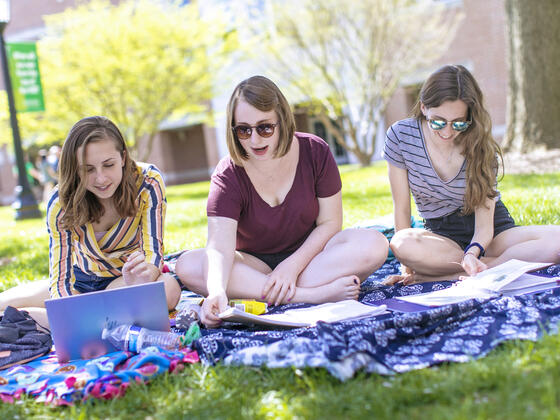
Three students sit on a blanket outdoors while facing the camera.

The McDaniel History Club

The McDaniel History Club gives students the opportunity to share their interests and promote history studies through films, lectures, and other extracurricular activities. Annually, senior History majors give their best advice to juniors on how best to plan and carry out a successful capstone research project, and everyone gets invited to the annual History Picnic.

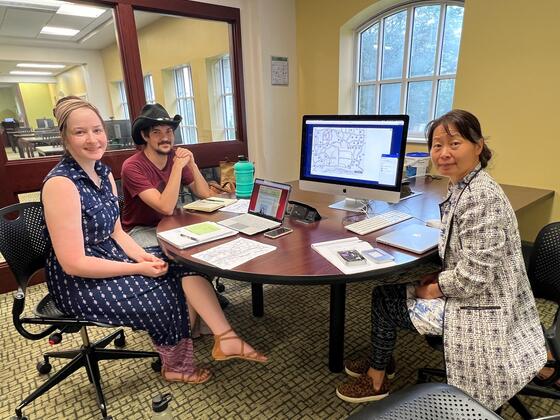
Two students sit with Professor Qin Fang in front of a computer that shows a map.

Student-Faculty Collaborative Summer Research Program Bringing the Past to Life

McDaniel History majors receive close faculty mentorship while conducting research in a broad array of subjects through cutting-edge techniques. Recently, two History majors worked with Associate Professor Qin Fang to create digital versions of ancient Chinese maps as part of their collaborative summer research. 

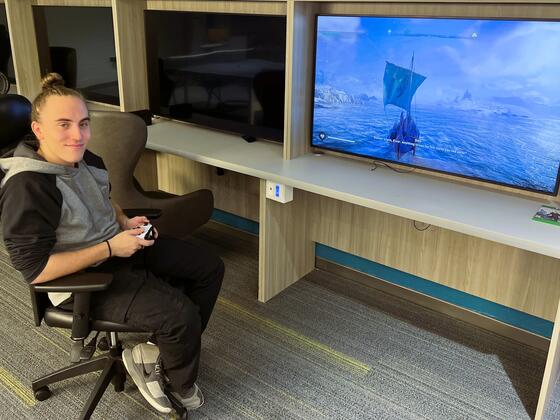
A male student holds a video game controller and smiles at the camera next to a large TV screen with a video game playing on it.

Unique First Year Seminars Dive into History from Day One

First-year students take a unique First Year Seminar during their first semester on campus. Course topics like The Middle Ages Through Video Games will take you on a journey through your favorite subjects.

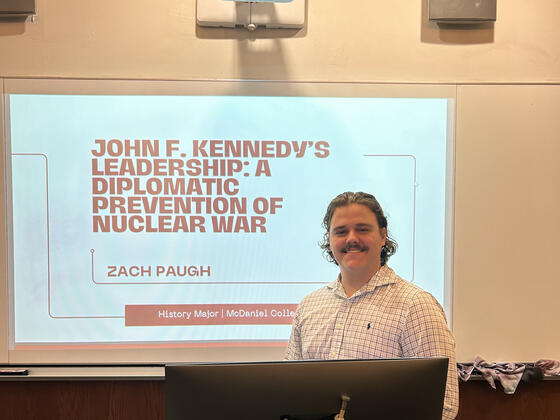
Zach Paugh History Academic Symposium 2024

Present at a Conference

McDaniel represents at the annual Phi Alpha Theta History Honor Society Mid-Atlantic Regional Conference - and often takes home a win. 

In 2024, senior Zach Paugh, History major from Easton, Maryland, won second prize in the American history division for his paper titled "John F. Kennedy’s Leadership: A Diplomatic Prevention of Nuclear War," which marked the 12th time since 2007 that a McDaniel student has won a prize at the conference. 

The McDaniel Commitment in Action
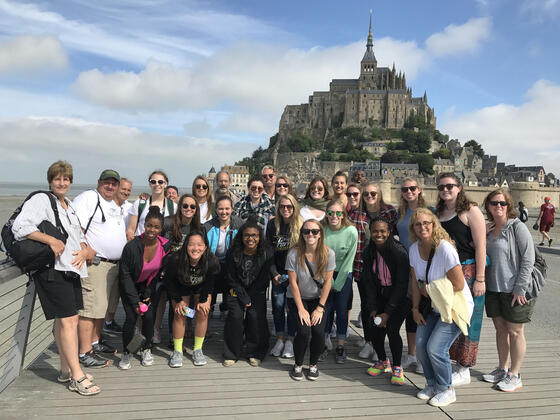
The McDaniel Commitment—a series of opportunities guaranteed to all students—provides enhanced mentoring and coaching, and ensures every undergraduate student completes at least two meaningful experiential learning opportunities.

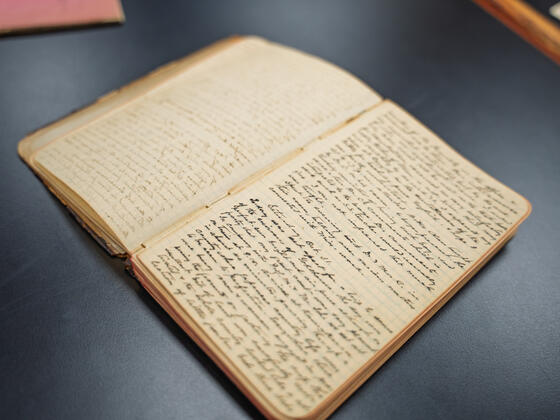
The diary of McDaniel's first president, J.T. Ward, from the 1890s.

History research unearths gold mine of material in McDaniel archives

Associate Professor Qin Fang P’18, Ph.D. and her students are transcribing letters and diaries from McDaniel’s first two presidents. As they step into the past, they uncover previously overlooked ties between the college and Asia, and they find connections that transcend both time and distance.

Group photo of students and a professor standing outside of Union Mills Homestead house.

Students investigate history firsthand at Union Mills Homestead

In an experiential course called Hands-On History, McDaniel students conducted research at Union Mills Homestead in Westminster, Maryland, for the spring 2025 semester. The historical site and its archives offer a unique chance to study artifacts in person and learn about public history.

Green Terror Alumni

A student sits outside at a table while reading a book.

Meet a Green Terror Class of 2024: Sydney Lewis English and History

With a dual History and English major, Sydney Lewis was well-equipped to contribute to McDaniel’s Westminster Detective Library through student-faculty research. 

"In the summer of 2022, I had the privilege of being an editorial assistant for Dr. Mary Bendel-Simso’s Westminster Detective Library, where I spent six weeks exploring online databases and archives to discover and recover detective stories that were written before the syndication of the Sherlock Holmes stories. In addition to actual research and work with the databases and archives, I curated, transcribed, edited, and uploaded these nearly forgotten detective stories to the Westminster Detective Library website."

A male student in a military uniform stands on the steps outside of Roj Student Center.

Student Spotlight Class of 2026: Nicholas Henderson History major | Green Terror Battalion ROTC

"The most mind-boggling thing I learned at McDaniel is how important history is in understanding the current world. Everything that has happened in the past builds upon itself and sometimes repeats. It is crucial to look back at the past to understand what might happen in the future."

History professor Stephen Feeley and senior Josh Irvin

Deep into a summer of research, senior Josh Irvin found the proverbial needle in a haystack — the one document, a letter written in 1805 by Revolutionary War general Jeremiah Slade, that detailed the deal that enabled the Tuscarora Indian nation to sell their reservation lands in North Carolina.

Abbi Wicklein-Bayne folding the American flag while wearing her ranger uniform.

Impressive Outcomes Abbi Wicklein-Bayne ’94 Living History

Abbi Wicklein-Bayne's ’94 passion for history was firmly established during her time as a History major at McDaniel. Post-graduation, she remained in Maryland for graduate school, immersing herself in local history, and found her ideal career as a ranger in the National Park Service at Fort McHenry.

History Program News