Skip to main
A professor leans over a student's shoulder while they look at a computer screen together.

Physics – Computer Science

With computer science transforming the world of physics every day, a degree in Physics - Computer Science from McDaniel College will equip you with the knowledge and skills you need to excel in your academic career and beyond.

Mortarboard
Degree Types
Major, Specialization
Institution
Complementary Programs
Heart
Distinctive Requirements
Capstone

Why McDaniel for your Physics - Computer Science degree?

When you're exploring degree options in STEM, you may be asking yourself, "Does Computer Science require Physics?" or vice versa, "Does Physics require Computer Science?" The fact is, the fields of computer science and physics are often intertwined in an increasingly digitized world. Technology has led to advances in physics and computers, and what professionals can accomplish by combining both. Physics programmer jobs are becoming ever more common, and the typical physicist spends time using or creating computer software to model data.

The Physics - Computer Science major will focus your studies on the fundamentals of scientific endeavors, critical thinking, and everything you need to know to pursue your dream career. 

moneycrosshairCreated with Sketch.
$139,220

Annual median salary for physicists in 2022, according to the U.S. Bureau of Labor Statistics.

Special Opportunities

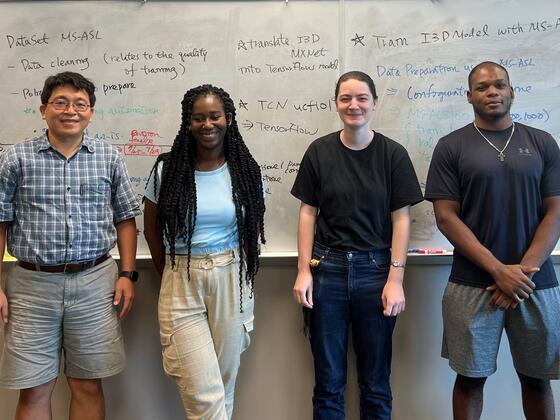
Professor Lin stands with his three summer 2022 research students.

Student-Faculty Research in Physics Maximize your summers

The annual Student-Faculty Collaborative Summer Research Program gives students an opportunity to work on a unique project with peers and faculty mentors. Previous Physics and Computer Science research projects include:

  • On the Dynamics of Droplets on Superheated Porous Surfaces with Assistant Professor Farzad Ahmadi

  • Sign Language Recognition and Translation using Machine Learning with Associate Professor Paul Lin

  • Integrating Object Recognition in Video Classification to Improve Accuracy with Associate Professor Ting Zhang


Distinctive Courses

PHY 1000 - Bosons to Bridges to Black Holes

Drawing examples from astronomy, physics, and engineering, this course will introduce students to fundamental conservation laws and the principles of statics and dynamics. In-class activities will help reinforce those concepts while improving students’ understanding of experimental design, measurement uncertainty, estimation, and data analysis. This course also will connect basic mathematics concepts to the physical sciences, while also introducing students to more advanced topics such as complex numbers and linear algebra.

ENR 2201 - Analog and Digital Circuits

This course is an introduction to circuit design and computer interfacing. Specific topics include resistive, capacitive, and inductive circuits; DC and AC circuits and their analysis; RLC circuits and resonance; filters; Kirchoff’s laws; operational amplifiers; theory and applications of logical gates; integrated circuits and their applications; digital counters and timers; and principles of computer interfacing. The laboratory component of the course will focus on designing and constructing analog and digital circuits, employing diagnostic  equipment, and using computer interfaces.

PHY 2202 - Intermediate Mechanics

This course covers classical Newtonian and Lagrangian mechanics as applied to the motion of particles and systems. Specific topics include solutions to Newton’s laws in the presence of retarding forces; conservation theorems; harmonic, damped, and forced oscillations, and resonance phenomena; phase-space diagrams; gravity and gravitational potential; Hamilton’s principle, Lagrange’s and Hamilton’s equations of motion, and generalized coordinates; central force motion and orbits in a central field; linear and angular momentum of a system of particles; and the dynamics of rigid bodies and the moments of inertia.

CSC 2217 - Data Structures

Study of data structures, recursion, searching and sorting algorithms. Introduction to complexity analysis of algorithms using Big-Oh notations.


McDaniel Commitment in Action

The McDaniel Commitment—a series of opportunities guaranteed to all students—provides enhanced mentoring and coaching, and ensures every undergraduate student completes at least two meaningful experiential learning opportunities.