Skip to main
A silhouette of someone pointing a telescope at a sky full of stars.

Astrophysics

Explore questions that go beyond the laboratory and into the cosmos. What’s the origin of the universe? How do we grapple with the nature of space and time? Astrophysics at McDaniel gives you the framework to turn curiosity into scientific discovery.

Mortarboard
Degree Types
Major, Minor
Institution
Complementary Programs
Document
Special Opportunity
Transfer agreement with Carroll Community College

At McDaniel, we take Astrophysics beyond the science. We’ll show you how it’s a combined human effort instead of a collection of abstract facts. Those big questions you think of when you look at the night sky? You’ll be able to navigate them both scientifically and philosophically. You’ll dive into the foundation of Astrophysics — from its international history to its technical content. Then, you’ll gain the skills to communicate some of the most complex concepts of the universe to a general audience.

Your first course will give you a foundation in Physics before we launch into the cosmos with lab work, telescopic observation, and more. Topics in the program include:

  • Quantum mechanics
  • Atomic processes
  • Statistical mechanics
  • Computational modeling
  • Astrophysics history

The sky’s the limit for your career options.

At McDaniel, we’re all about collaboration. Our faculty provide mentorship tailored to your specific goals. With their guidance, you’ll gain skills that are adaptable to a variety of careers. You’ll learn to identify the difference between what’s known and what’s uncertain. You’ll critically review evidence and adapt your skills to unique challenges. We give you the creative and technical skills that’ll take you far in your career.

Possible career paths include:

  • Aerospace engineering
  • Planetarium programming
  • Science communication
  • Research
  • Data science
moneycrosshairCreated with Sketch.
$132,170

Average wage for astronomers

starCreated with Sketch.
1,800

Annual job openings for physicists and astronomers

We're a short drive from astrophysics employers.

Our location in Maryland puts us right in the center of an astronomical research hub. You’ll have easy access to multiple labs and institutes. Located either in-state or within driving distance are:

  • NASA Goddard Space Flight Center
  • Space Telescope Science Institute (featuring the Hubble and James Webb space telescopes)
  • Johns Hopkins University Applied Physics Laboratory
  • National Oceanic and Atmospheric Administration (NOAA) Environmental Satellite, Data, and Information Service
  • Private aerospace companies and defense contractors in Maryland
  • Federal science agencies, think tanks, and consulting firms in Washington, D.C.

Distinctive courses

Our Astrophysics courses cover everything from computational modeling to the evolution of stars. With lab work and research projects, your technical skills grow throughout the program. At the same time, you’ll also get the historical and cultural contexts. We make sure your knowledge covers Astrophysics and beyond.

PHY 1000 – Bosons to Bridges to Black Holes

Drawing examples from astronomy, physics, and engineering, this course will introduce students to foundational physical principles in the areas of statics, dynamics, fluids, and thermodynamics, as well as topics at the forefront of science. In-class activities will help reinforce those concepts while improving students’ understanding of experimental design, estimation, and data analysis. This course also will connect basic mathematics concepts to the physical sciences, while also introducing and applying more advanced mathematical topics.

ASR 2110 - Galactic Astronomy

Galaxies serve as a fundamental building block of our universe. This course aims to build a comprehensive picture of galaxies through developing an understanding of the physical principles that govern galactic phenomena, and the methods astronomers use to study them. Topics will include galactic structure; evolution; dynamics and interactions; and denizens, such as stars, pulsars, quasars, interstellar medium, and black holes.

ASR 2115 – Observational Astronomy

Astronomy is fundamentally an observational science, and this course introduces students to various observational techniques that involve subatomic particles, electromagnetic radiation, and gravitational waves. Emphasis is placed on the physical principles underlying gravitational distortions of space-time, sub-atomic particles, and electromagnetic emissions, as well as ground and space-based telescope design, detectors, experimental techniques, and data analysis.

ASR 3010 – Relativity and Cosmology

This advanced course for Astrophysics majors presents a comprehensive treatment of Einstein’s theory of gravity and its application to modern cosmology. Topics include the mathematical framework of general relativity, black holes, gravitational waves, and the origins and dynamics of the expanding universe. Students will examine cosmological models, dark matter and dark energy, and crucial observational tests of cosmological theories.

The McDaniel Commitment in Action

The McDaniel Commitment — a series of opportunities guaranteed to all students — provides enhanced mentoring and coaching, and ensures every undergraduate student completes at least two meaningful experiential learning opportunities.

Special Opportunities

Two students chat and walk on the McDaniel campus.

Transfer Agreement with Carroll Community College

Students who complete appropriate coursework at CCC or other community colleges will receive full credit toward the major, up to 64 credits.

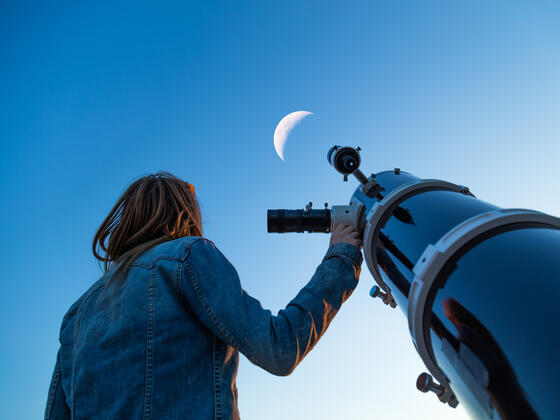
A woman holds a telescope and looks at the moon in the sky.

Remote Telescope Access

Clouds over Westminster? Don’t worry — you’ll still be able to see the stars! McDaniel College partners with the Las Cumbres Observatory for access to its remote telescope array. In addition to our own telescopes on campus, you’ll have access to state-of-the-art equipment from miles away.

Jeff Marx

Faculty Spotlight Jeff Marx Professor and Department Chair

Professor Marx is the recipient of a $170,000 National Science Foundation grant to develop a novel science course for non-science majors on “The Nature of Science,” which dovetails with his student-centered interests in developing curricular materials to minimize these student difficulties in learning physics and working with students to help them conceive, design, and analyze their own physics projects such as the physics of various sports.

An Engineering professor experiments with lasers in a lab.

McDaniel adds new undergraduate majors in Astrophysics, Astronomy, and Engineering Mechanics

McDaniel College announces new majors in Astrophysics, Astronomy, and Engineering Mechanics to begin fall 2027. Incoming fall 2026 students will have the opportunity to be able to declare one of these new programs as their major in their sophomore year.