Skip to main
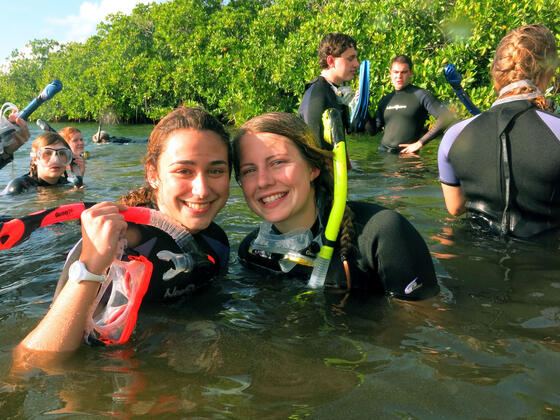
Jackie Fahrenholz in Indonesia for student research.

Environmental Studies

As the political debate over climate change rages, the need for highly trained environmental specialists has never been more urgent. McDaniel’s Environmental Studies major offers multiple tracks, so you’ll be equipped to fight this battle on many fronts.

Mortarboard
Degree Types
Major, Minor
Institution
Complementary Programs
Heart
Distinctive Requirements
Capstone
Document
Spaces for Research

The Environmental Studies degree at McDaniel College prepares you to become a leader, problem-solver, and environmental professional. With a focus on experiential learning and the scientific method, you’ll delve into the interdisciplinary study of human-environmental relations with a focus on human influences on the environment and environmental problem-solving.

As an Environmental Studies major, you’ll explore contemporary environmental issues and develop professional competencies through innovative courses. Program graduates have the knowledge and skills needed to address socio-ecological challenges and create a better world.

Future Career Paths

Environmental Studies students will be well prepared for graduate study and to pursue careers as:

  • Policy analysts
  • Science researchers
  • Environmental consultants
  • Environmental health specialists
  • Urban or regional planners
  • Science educators
  • Naturalists

Distinctive Courses

ENV 1135 - Urban Ecology

Cities are complex ecosystems where people and nature interact in unique and surprising ways. In this course, we will explore the ecology of the "concrete jungle". We will study the ways that humans have modified the natural environment and how animals and plants have adapted to novel conditions like urban light, heat, and noise. We will also investigate urban wildlife conservation and the ways that wildlife impact our lives by providing ecosystem services like purifying our air, cleaning up litter, and mitigating urban heat. The course is designed to provide experience designing and implementing urban ecology field experiments. It will culminate in a final project exploring how urbanization impacts wild organisms across Westminster and Carroll County.

ENV 2151 - Sustainability

Sustainability in its simplest form is the continuation of a process. When proposed for human and natural systems, sustainability aims to meet the needs of the present while considering the needs of the future. To achieve this vision sustainability requires navigating many of the social and environmental challenges faced in our contemporary era. Within this course we will explore these challenges alongside the myriad of opportunities available to develop new solutions and scale-up those solutions already available. To achieve these course goals, this class combines interactive lectures, discussions, and individual and team-based assignments that examine sustainability globally, locally, and personally.

ENV 3110 - Climatology

Understanding processes that have affected climate in the past will help us predict future global warming. In this course, we will explore how the climate of the Earth has changed in the past, what caused past climate changes, and how we know. We will investigate concepts such as Faint Young Sun, Milankovitch Cycles, and “snowball Earth” and the connections between Earth’s systems and its climate.

ENV 3T03 - Restoration Ecology

Humans have made countless changes to the landscapes and ecosystems on Earth. Restoration ecology is the science of putting the pieces back together. In this course we will combine thoughtful scrutiny of the philosophy behind the discipline of restoration ecology with active engagement in its practice. Field trips to sites around our region will showcase local restoration efforts and the course will culminate in student-driven projects in a local natural area.

Environmental Studies Program Requirements

The McDaniel Commitment in Action
The McDaniel Commitment—a series of opportunities guaranteed to all students—provides enhanced mentoring and coaching, and ensures every undergraduate student completes at least two meaningful experiential learning opportunities.

Experiential Learning

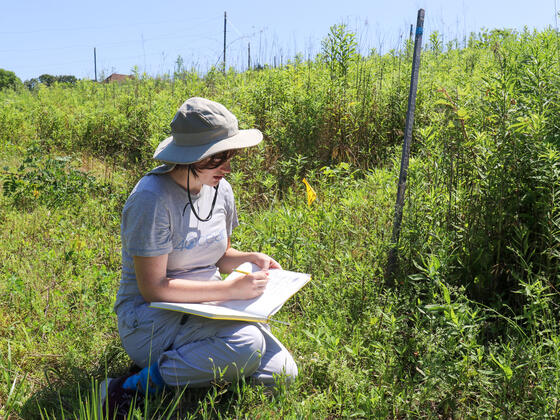
A student kneels among tall plants, taking notes

McDaniel Environmental Center

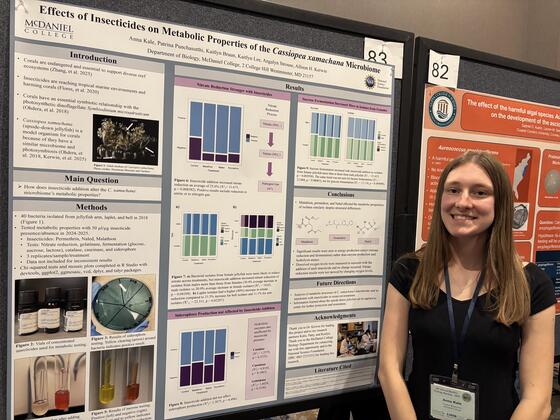
The McDaniel Environmental Center (MEC), located in Carroll County, Maryland, is a student-powered hub for collaborative and experiential learning opportunities, particularly in environmental studies, agriculture, and undergraduate research related to the natural world.

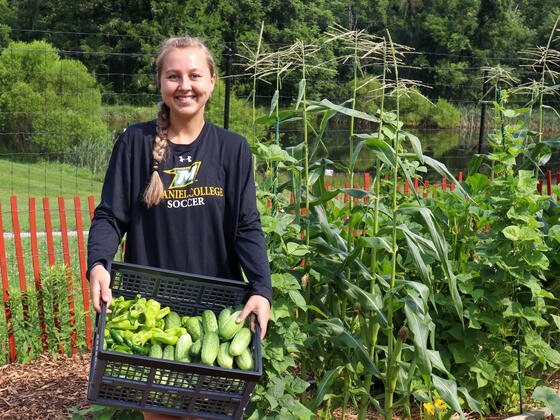
A student stands in a garden holding a crate full of harvested vegetables.

Gardens Galore

Environmental Studies students get their hands dirty in interactive garden lessons — at the campus garden located near Harvey Stone Pavilion, the McDaniel greenhouse, or the Shaffer Forest Garden, which includes a plot for the beloved Jam Garden.

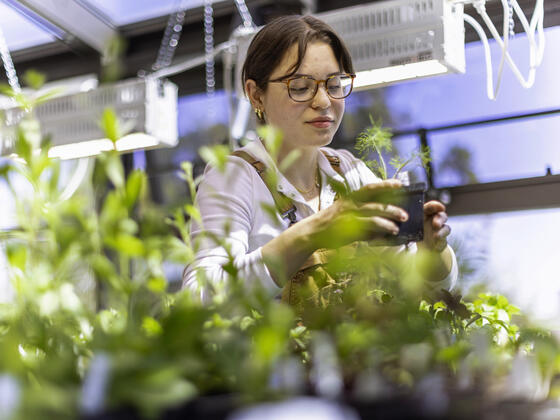
A student works with plants inside the McDaniel greenhouse.

McDaniel Greenhouse

Updated with new grow lights, benches, mobile carts, and potting casework and counters, the McDaniel greenhouse is the perfect space for hands-on learning. The flowers, herbs, vegetables, and other plants grown by students and faculty in the greenhouse are often given away to the McDaniel community at no cost.

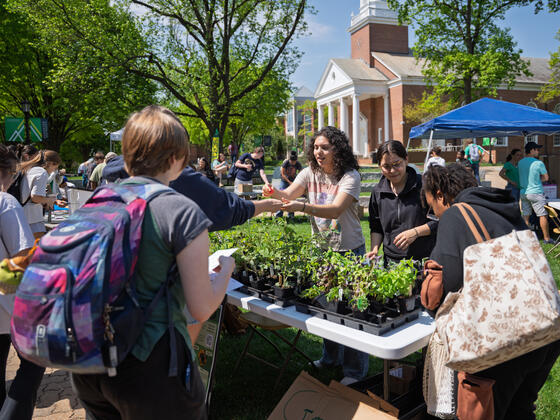
Students hand out free plants at the Earth Day Fair.

Feeding a Hunger for Connection: Little Free Seed Library Launches at the 2026 Earth Day Fair

With new environmental and sustainability initiatives taking root here at McDaniel — such as the annual Earth Day Fair, projects at the McDaniel Environmental Center, a redeveloped campus garden, and a newly renovated greenhouse — the time is finally right for a seed library to come to campus.

A student smiles to the side while walking with a backpack on their shoulder.

Meet a Green Terror Alum Class of 2024: Lauren Portis Career Experiences in Environmental Studies

"Assistant Professor Elly Engle gave me the opportunity to participate in McDaniel’s Agrifood Program, working at the McDaniel Environmental Center (MEC) managing the Schaffer Forest Garden. I was also able to do summer research with Dr. Engle on agroforestry design, as we planned and planted a jam garden."

person with brown hair stands in front of trees

Faculty Q&A Terra Swartz, Ph.D.

A college Tropical Biology course in Costa Rica clinched it: Terra was destined to be a biologist. “I love teaching liberal arts students in science classes because they are so excited to cross disciplinary boundaries and draw on their broad academic experiences to find ways to solve ecological problems,” she says. 

With a B.S. in Biology from Messiah University, an M.S. in Natural Resources and Environmental Sciences from University of Illinois at Urbana-Champaign, and a Ph.D. in Biology from Temple University, Terra is excited to teach the next generation at McDaniel.

Recent News for Environmental Studies